

The owner of a Grade II listed Georgian townhouse on Cockermouth Main Street contacted us after their surveyor identified serious mortar deterioration in both chimney stacks. The property — a three-storey sandstone townhouse dating from the 1780s — had two substantial multi-flue chimneys, both showing open joints, crumbling flaunching and loose pots following decades of exposure to weather sweeping down the Cocker valley.
The work required full repointing of both stacks using lime mortar to match the original, replacement of all flaunching, re-seating of the original clay pots, and installation of new lead soakers where the stacks met the slate roof. As a listed building within Cockermouth’s conservation area, the project needed heritage-grade scaffold access that would protect the building’s historic fabric throughout the works.
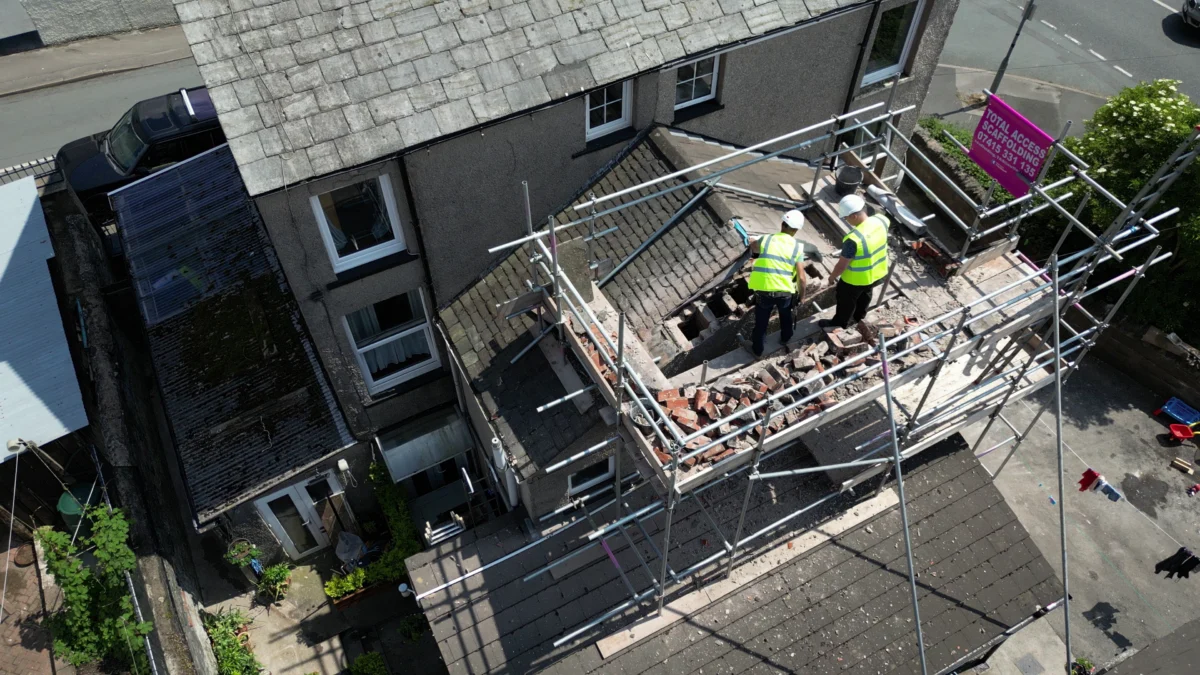
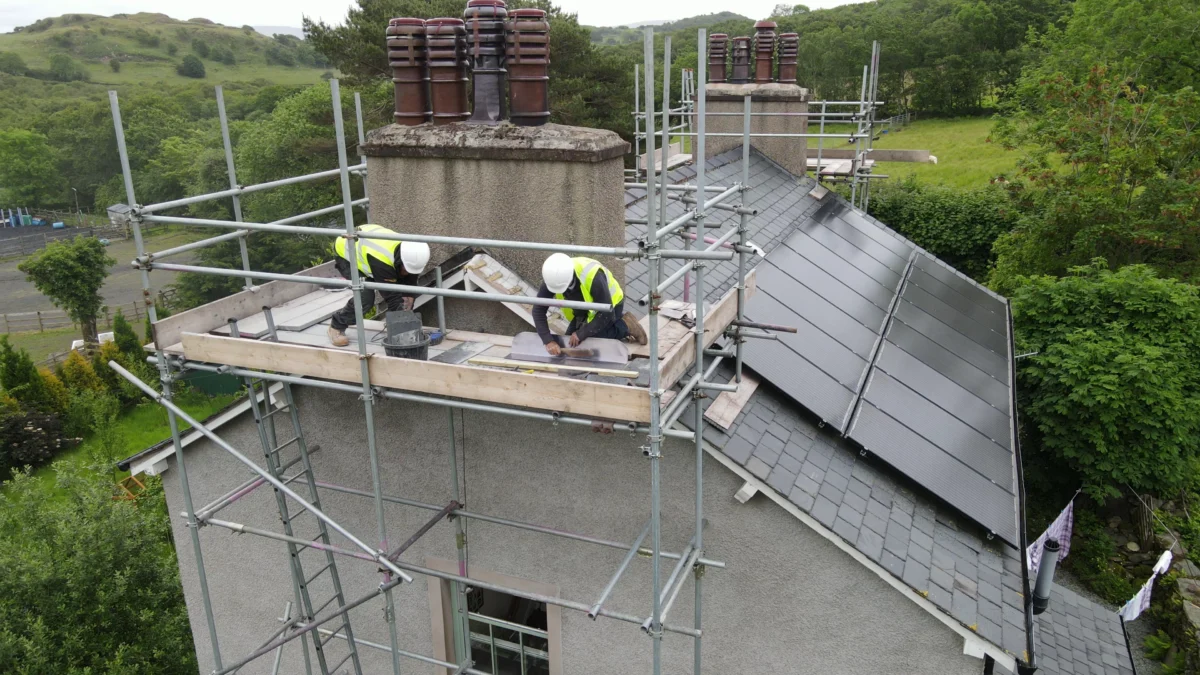
We erected dedicated chimney scaffolding to both stacks, each rising from a base scaffold at eaves level to a working platform surrounding the full circumference of the chimney head. The base scaffold was independent — standing clear of the sandstone facade to avoid any contact with the dressed stone frontage. Protective non-marking pads were fitted at every tie position, and scaffold boards were placed to prevent scuffing against the original stone window sills and string course.
Both chimney platforms included secure material storage areas for lime mortar, replacement stone and lead sheet, plus a dedicated staircase access tower on the rear elevation so the stonemason could reach the working platform without climbing through the building. The scaffold was formally inspected before handover and a photographic record was prepared for the conservation officer’s project file.
Cockermouth Main Street is one of the busiest pedestrian thoroughfares in the town, and the property’s frontage sits directly on the pavement. We installed a pedestrian canopy along the full frontage to protect passers-by from any falling material during the chimney work above. The canopy was designed to maintain full pavement width and unobstructed access to the shop next door.
The listed status of the building added further constraints. All scaffold fixings had to avoid the original lime mortar joints, and the independent design meant no through-ties penetrated the historic fabric. The rear elevation overlooked a narrow yard with limited vehicle access, so all scaffold materials were hand-carried from the delivery point on a side lane. The conservation officer required a method statement before work commenced, which we provided as part of our standard heritage scaffolding service. Cockermouth’s flood history also meant we needed to confirm the ground-floor structure could bear scaffold base loads without risking damage to flood-resilience measures installed after the 2015 event — a consideration we encounter regularly on renovation projects in this town.
Both chimney stacks were fully repointed in lime mortar over a three-week programme. All flaunching was replaced, original clay pots were re-seated, and new lead soakers were dressed into the roof junction at both stack positions. The scaffold was dismantled carefully, leaving the listed facade completely unmarked. The conservation officer confirmed the work met all conditions of the listed building consent, and the client was delighted with a result that will protect both chimneys for the next fifty years.
Call 07415331135 to discuss your chimney or heritage scaffolding project. We provide free site surveys and detailed quotations. Or contact us through our contact page. Find out more about us.
