

We received an urgent call from Workington borough council’s building control team on a stormy November afternoon. A chimney stack on an end-terrace house in Harrington had partially collapsed during sustained 60mph winds, with approximately a tonne of sandstone masonry falling onto the roof below and scattering across the pavement and road. The building control officer had issued a dangerous structure notice and cordoned the area, but needed scaffold access urgently to make the remaining stack safe and clear the debris from the damaged roof.
This was a critical emergency response situation. The remaining chimney masonry was unstable, the roof beneath the collapse point was holed, and further gusts were forecast overnight. The building control officer needed the dangerous masonry removed and the roof temporarily sheeted before dark. Every hour of delay increased the risk of further collapse onto the street below, where the cordon was disrupting traffic on a residential through-route.
Our emergency crew arrived within two hours with pre-loaded scaffold components. We erected a rapid independent scaffold on the gable end to above the remaining chimney height, with a working platform allowing the dangerous masonry to be dismantled safely course by course from the top. A protective canopy was installed at first-floor level to shield the pavement below from any further falling debris during the dismantling.
The scaffold was built using our emergency pre-assembled frame sections for maximum speed — the full structure was standing within three hours of arrival. A temporary shore was placed against the remaining stack section to prevent further lateral movement while the dismantling crew worked from the platform above. Once the dangerous masonry was removed, a roofer working from our scaffold platform applied temporary sheeting over the hole in the roof below the collapse point to prevent overnight water ingress.
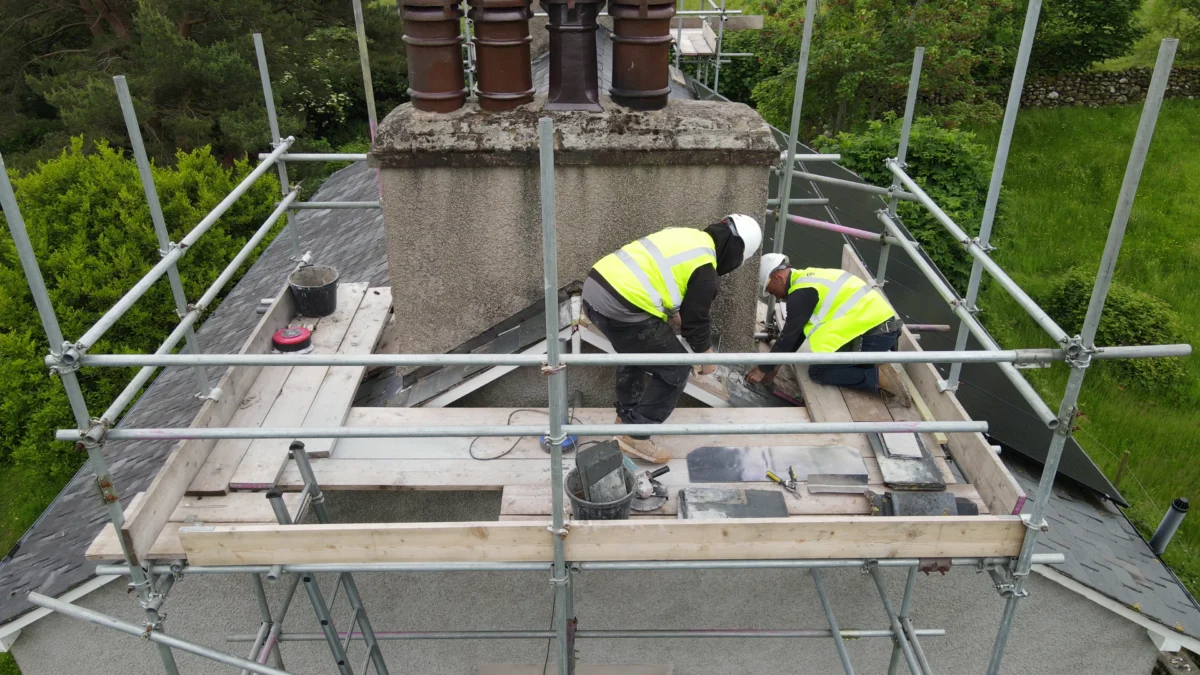
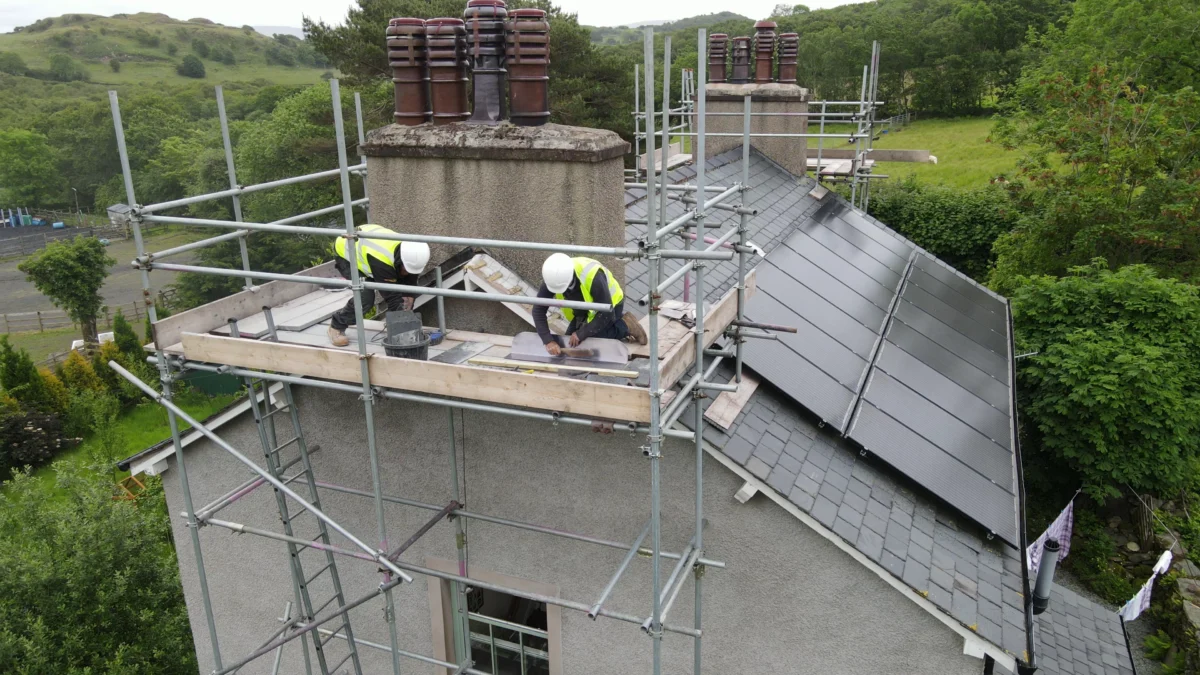
We were erecting scaffold in active storm conditions with gusts still exceeding 50mph. Our operatives worked in helmets with chin straps, and we built the lower lifts first for stability before adding upper sections during lulls between gusts. Additional bracing was fitted at every standard on the exposed gable end to resist the sustained wind loading. The building control officer remained on site throughout and confirmed each stage was safe before we proceeded to the next lift.
The collapsed masonry had damaged the roof on both the affected property and the neighbouring house, scattering debris across both rooflines. Our scaffold had to be positioned to allow roof access on both sides of the party wall — we extended the scaffold width to cover the neighbour’s roof edge as well, which the council authorised under the dangerous structure powers. All work was fully documented from arrival with timestamped photographs for the homeowner’s insurance claim. Workington’s terraced housing stock has a high proportion of ageing chimney stacks, and this type of emergency callout is an unfortunately regular part of our winter workload across west Cumbria.
The dangerous stack was fully dismantled by nightfall — approximately seven hours after our initial call. The road cordon was lifted the following morning after the building control officer confirmed the structure was safe. The temporary roof sheeting held through a week of further storms. Permanent chimney rebuilding and roof repair commenced the following week using our scaffold, which remained in place for a further three weeks. Both the homeowner and the neighbouring property owner submitted insurance claims supported by our comprehensive photographic and inspection documentation.
Call 07415331135 immediately for emergency chimney scaffolding. We respond 24 hours a day. Or contact us through our contact page for non-urgent chimney work. Find out more about us.
