

Staircase scaffolding refers to scaffold stair tower systems that provide safe, compliant staircase access to scaffold platforms and elevated working areas. Where operatives need to access a scaffold level repeatedly throughout a working day — carrying tools and materials — a scaffold staircase is substantially safer, more efficient and more legally compliant than ladder access. The Working at Height Regulations 2005 require that where staircase access to a working platform is practicable, it should be provided in preference to ladder access.
We supply and erect scaffold stair towers as standalone structures or integrated into a wider scaffold system. Standalone stair towers are particularly useful for providing access to upper floor areas during construction, conversion and major refurbishment works across Cumbria and the Furness Peninsula. For the main access scaffold that the stair tower serves see our independent scaffolding page. For hanging scaffold platforms requiring stair tower access see our hanging scaffolding page. We manage all highway permits where the stair tower encroaches on a public footpath. Call 07415331135 for a free site assessment.
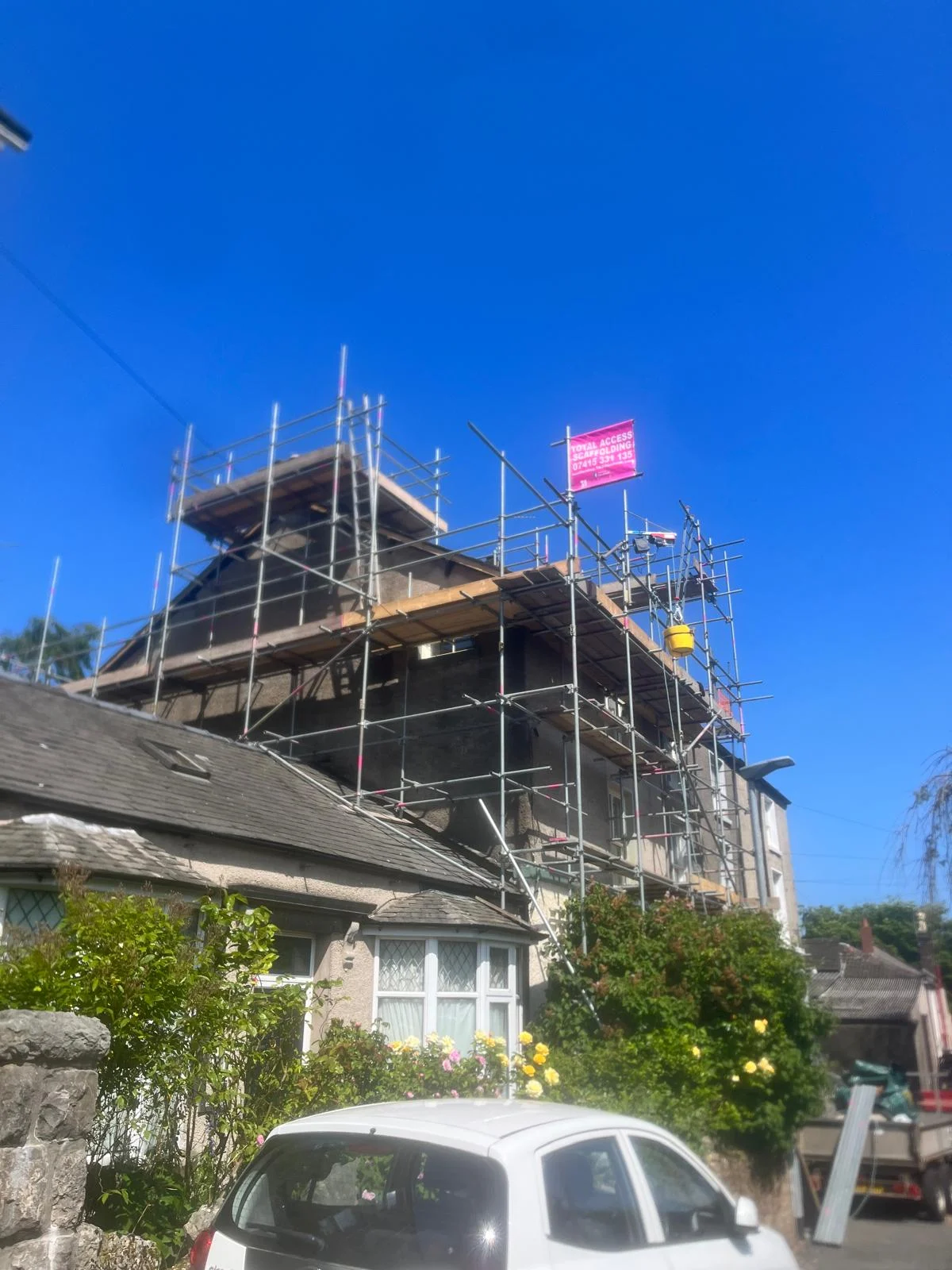


Every scaffold staircase we design and erect is sized and configured to match the specific access requirements of your project. We consider the number of operatives needing access, the frequency of use, the materials and loads being carried, the available footprint for the stair tower, and the heights and levels to be accessed. From this assessment we select and erect the right stair tower system — whether a narrow footprint tower for a tight Cumbria terrace or heritage site, or a wider system for a large commercial or new build project.
We integrate scaffold stair towers with the main scaffold structure wherever possible, providing level access from the stair tower landing directly onto the working platforms of the main scaffold. Where a standalone stair tower is required, we ensure it is properly tied or braced for stability and that the access points between the tower and the working level are safe and clearly defined. All landings, stair flights and handrails comply with the relevant British Standards for temporary stair access. For the main access scaffold that the stair tower serves see our independent scaffolding page. For hanging scaffold platforms requiring stair tower access see our hanging scaffolding page.
We manage all permit applications where a stair tower or its associated fan or landing encroaches on a public pavement or highway. On Cumbria’s older terraced streets this is a common requirement, and we factor the permit lead time into your programme to avoid delays to your scaffold erection date. All stair towers are erected by CISRS-carded operatives in full compliance with the Working at Height Regulations 2005, and we provide full inspection records and handover certificates on every job.
Fast, simple and fully documented — getting safe stair access to your Cumbria project without delay.
We cover staircase scaffolding throughout Cumbria and the Furness Peninsula — from Haverigg and Silecroft to Kirksanton, Green Road and the rural communities inland. We also cover Barrow, Dalton, Ulverston, Askam, Grange.
Other scaffold types in Cumbria: independent scaffolding, birdcage scaffolding, chimney scaffolding, canopy scaffolding, support scaffolding, hanging scaffolding, bridging scaffolding, 8ft scaffold towers, 10ft scaffold towers, 13ft scaffold towers, temporary staging. Visit our Cumbria scaffolding hub for the full picture, or call 07415331135 for a free no-obligation site visit.
The Working at Height Regulations 2005 require that where it is practicable to provide staircase access to a working platform rather than ladder access, staircase access should be used. In practice this means that for any scaffold where operatives are accessing the platform repeatedly throughout the working day, carrying tools or materials, a scaffold staircase is required. Your principal contractor and CDM coordinator can advise on the specific requirements for your project. For the main scaffold structure see our independent scaffolding page.
Yes — we have narrow-footprint scaffold stair tower systems suitable for the tight access conditions typical of Cumbria’s older terraced streets. Where a stair tower cannot be positioned within the property boundary, we may need to extend it over the pavement, which requires a highway scaffold licence from Westmorland and Furness Council. We manage that permit application on your behalf and factor the lead time into your programme.
Standard scaffold stair towers typically provide a clear stair width of 600mm with a vertical rise of approximately 1.5m per flight. Headroom on the stair flights and at landings meets the requirements of the relevant British Standards for temporary stair access. Where your project requires wider access or higher capacity, we can specify heavy-duty stair tower systems with greater clear width and load capacity. We confirm all dimensions at the quotation stage.
Yes — scaffold stair towers can be extended in height as your build progresses, adding stair flights and landings at each new level as it becomes accessible. We coordinate this adaptation with your construction programme, ensuring the stair tower always provides access to the highest working level on the scaffold. We provide a new inspection and handover certificate each time the stair tower is adapted or extended.
Yes — scaffold stair towers are scaffold structures and are subject to the same weekly inspection requirements as any other scaffold under the Working at Height Regulations 2005. We carry out weekly inspections of all stair towers we erect, with inspection records retained throughout the hire period. We also inspect after any significant weather event and after any incident that may have affected the structure. Copies of all inspection records are available to you and your principal contractor on request. Find out more about us.
